


Playing competitive junior tennis has allowed me to visit so many places for tournaments. I have travelled to Spain, Tajikistan, Saudi Arabia, Bahrain, Dubai, Nepal, India, China, Indonesia, Malaysia, Thailand, Singapore and Japan.
Typically, as we arrive in a new country, hydration is the topmost on our list. Long flights, time zone changes and only a day to recuperate before the match make hydration key.
My parents and I usually buy 6 cases of 1-litre bottles to start off with. Especially with the hotels only offering 500 ml per person per day complimentary, even in countries like India, Bahrain, Thailand, with the temperature outside being over 35 degrees often.
Across my travels, I noticed a few things
- The price of a 1 Liter bottle fluctuated a lot across countries
- Buying in bulk was much cheaper e.g. 6 2.5 L bottles versus a 1 L bottle
- The price of a 1 L bottle in the hotel or restaurant was so much higher than at the supermarket
I wondered, water is water. So WHY the difference in prices?
India $0.24 ( Bisleri, Aquafina, Kingsley)
Spain $0.50
Tajikitan $0.70
Saudi Arabia $0.61
Bahrain $0.20
Dubai $0.80
Nepal $0.17
China $0.70
Indonesia $0.70
Thailand $0.06
Malaysia $0.55
Japan $0.85
Singapore $1.50
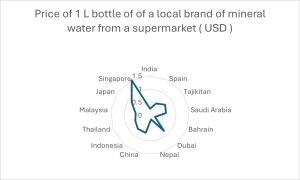
As I researched this topic more based on my initial observation and found to my surprise that the variation existed even in markets I had not visited. WHY IS THIS????
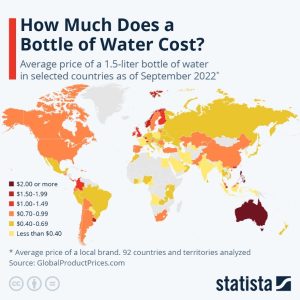
As I explored the economics behind this question, I understood that several factors determine why these prices vary so much
- Cost of production, which is linked to the source of the water, treatment costs, policies, taxes, packaging and transportation etc.
- These vary by country ad hence impact the prices of good sold in that market.
But then, how does one compare across markets to understand the financial implications of visiting from a narrow view and also from a macroeconomic viewpoint?
As a student interested in studying Economics, I connected the concept of Purchasing Power Parity to answer my question.
Where Purchasing Power Parity is used to compare the price of similar goods across countries to take out the differences in the standard of living and economic standing and income levels between countries. It creates a currency of comparison.
One could ask why not just use the currency conversion and here is my understanding
The average cost of a 1L local brand bottle of mineral water in the USA is $1.50 which @of 90 INR for a US Dollar currency conversion would be INR 135. But the price of a 1L local brand bottle of mineral water in India is INR 22. Which reflects the power of PPP as a concept which is to equalise the purchasing power of currencies.
This essentially gives us a truer picture of the GDP comparison across countries.
I then also learnt about the ‘Big Mac Index’ but for me what taught me to understand these two concepts was my ‘Water Index’ observation.
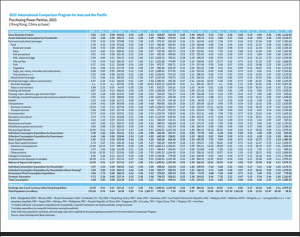
But surely the PPP approach cannot be based on a few select product and services, as the difference in cost could vary a lot across a range of products and services. Which lead to the United Nations Statistical Commission and the University of Pennsylvania establishing the International Comparison Program, which conducted a global survey of prices.
I understood the difference between PPP and the currency exchange rate approach better after looking at this ICP data. The difference in the overall aggregate Indian PPP, once we take an aggregate view, is different from just looking at this through the lens of bottled water. But it does highlight the huge difference (approx. 3 fold) between PPP and exchange rate comparison.
But also, Singapore, for example, has a PPP close to the exchange rate conversion which matched my observation that water was expensive in Singapore and I now understand why. Specific areas really pulled Singapore out on the PPP comparison – Transportation, Purchase of vehicles, communication and tobacco products. Communication costs being a fallout of advanced infrastructure costs and higher income and consumption levels.
I always had a sense that travelling from my tennis tournaments was not cheap, and including cost of stay at the tournament country is now part of my input factors I consider when evaluating one destination versus the other. And I don’t only compare the currency exchange rate but also the PPP comparison.